Friday, 23 February 2018

Friday, 9 February 2018
Week 11
We did a family tree and asked my friend to exchange it and write a short essay about it.
Parents (父母 – fù mǔ)
father (父亲 – fù qīn)
dad (爸爸 – bà ba)
mother (母亲 – mǔ qin)
mom (妈妈 – mā ma)
siblings (兄弟姐妹 – xiōng dì jiě mèi)
older brother (哥哥 – gē ge)
younger brother (弟弟 – dì dì)
older sister (姐姐 – jiě jie)
younger sister (妹妹 – mèi mei)
grandparents (祖父母 – zǔ fù mǔ)
paternal grandpa (爷爷 – yé ye; 祖父 – zǔ fù)
paternal grandma (奶奶 – nǎi nai; 祖母 – zǔ mǔ)
maternal grandpa (外公 – wài gōng; 老爷 – lǎo ye)
maternal grandma (外婆 – wài pó; 姥姥 – lǎo lao)
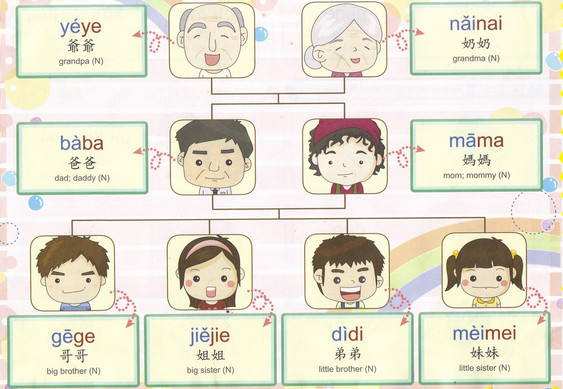
Parents (父母 – fù mǔ)
father (父亲 – fù qīn)
dad (爸爸 – bà ba)
mother (母亲 – mǔ qin)
mom (妈妈 – mā ma)
siblings (兄弟姐妹 – xiōng dì jiě mèi)
older brother (哥哥 – gē ge)
younger brother (弟弟 – dì dì)
older sister (姐姐 – jiě jie)
younger sister (妹妹 – mèi mei)
grandparents (祖父母 – zǔ fù mǔ)
paternal grandpa (爷爷 – yé ye; 祖父 – zǔ fù)
paternal grandma (奶奶 – nǎi nai; 祖母 – zǔ mǔ)
maternal grandpa (外公 – wài gōng; 老爷 – lǎo ye)
maternal grandma (外婆 – wài pó; 姥姥 – lǎo lao)
Thursday, 8 February 2018


Thursday, 1 February 2018


Wednesday, 31 January 2018


Tuesday, 30 January 2018
Week 7
Directions To Know and Learn! Lesson #5
Zuobian 左边 - Left
Yuobian 雨哦变 - Right
Shangmian 上面 - Up
Xiamian 下面 - Down
Zhongjian 中间 - In the middle
Limian 里面 - Inside
Waimian 外面 - Outside
Duimian 对面 - Opposite
Pangbian 旁边 - Next to you
Qianmian 前面 - In front
Houmian 后面 - Behind
A lil update on lesson 5
Zuobian 左边 - Left
Yuobian 雨哦变 - Right
Shangmian 上面 - Up
Xiamian 下面 - Down
Zhongjian 中间 - In the middle
Limian 里面 - Inside
Waimian 外面 - Outside
Duimian 对面 - Opposite
Pangbian 旁边 - Next to you
Qianmian 前面 - In front
Houmian 后面 - Behind
A lil update on lesson 5
Thursday, 25 January 2018


Thursday, 18 January 2018
Week 5
In week 5 , We learned to write and practiced writing Chinese characters from lesson 1 and 2 .


Tuesday, 16 January 2018
Week 4
We learned about Initials this week !
Initials
There are 21 initials in Chinese and 12 of them have almost the same pronunciation as English.
m, f, n, l, h, and sh are pronounced as in English
d like “t” in “straight”(unaspirated)
j like “g” in “genius” (unaspirated)
z like “ds” in “beds”
zh like “j” in job
b like “p” in “spin” (unaspirated)
g a soft unaspirated “k” sound
x like “sh” in “sleep” but with the corners of the lips drawn back
r somewhat like “ge” in lodge
There is some special attention to be paid on the so called “aspirated” consonants. It is necessary to breath heavily after the original consonant is sounded:
p = p'(like in “pop”)
q = ch harder than “ch” in cheap
t = t’ (like in “tap”)
c = ts’ (like in “cats”), with aspiration
k = k’ (like in “kangaroo”)
ch = ch’ (tongue curled back, aspiration)
Tones
Tone Tone Mark Description Example
First Tone First Tone high, level pitch 妈 mā = mother
Second Tone Second Tone starting high and rising 蔴 má = hemp
Third Tone Third Tone falling first, then rising 马 mǎ = horse
Fourth Tone Fourth Tone starting high and falling 骂 mà = scold
Got this info online and its pretty impressive.
Initials
There are 21 initials in Chinese and 12 of them have almost the same pronunciation as English.
m, f, n, l, h, and sh are pronounced as in English
d like “t” in “straight”(unaspirated)
j like “g” in “genius” (unaspirated)
z like “ds” in “beds”
zh like “j” in job
b like “p” in “spin” (unaspirated)
g a soft unaspirated “k” sound
x like “sh” in “sleep” but with the corners of the lips drawn back
r somewhat like “ge” in lodge
There is some special attention to be paid on the so called “aspirated” consonants. It is necessary to breath heavily after the original consonant is sounded:
p = p'(like in “pop”)
q = ch harder than “ch” in cheap
t = t’ (like in “tap”)
c = ts’ (like in “cats”), with aspiration
k = k’ (like in “kangaroo”)
ch = ch’ (tongue curled back, aspiration)
Tones
Tone Tone Mark Description Example
First Tone First Tone high, level pitch 妈 mā = mother
Second Tone Second Tone starting high and rising 蔴 má = hemp
Third Tone Third Tone falling first, then rising 马 mǎ = horse
Fourth Tone Fourth Tone starting high and falling 骂 mà = scold
Got this info online and its pretty impressive.
Thursday, 11 January 2018
Week 3
As usual learned more words this weeks and it was really fun engaging in the class. Had a little hard time when laoshi asked a few in chinese and I was totally unable to answer hahah.
周 zhōu - week
年 (n) nián - year
今天 jīntiān - today
明天 míngtiān - tomorrow
昨天 zuótiān - yesterday
日历 rìlì - calendar
秒 miǎo - second
小时 xiǎoshí - hour
分钟 fēnzhōng - minute
点 diǎn - o'clock
钟表 zhōngbiǎo - clock
And we also had learn a few greetings suchs as
Zǎoshàng hǎo , Good morning ;
Wǎnshàng hǎo , Good evening ;
周 zhōu - week
年 (n) nián - year
今天 jīntiān - today
明天 míngtiān - tomorrow
昨天 zuótiān - yesterday
日历 rìlì - calendar
秒 miǎo - second
小时 xiǎoshí - hour
分钟 fēnzhōng - minute
点 diǎn - o'clock
钟表 zhōngbiǎo - clock
And we also had learn a few greetings suchs as
Zǎoshàng hǎo , Good morning ;
Wǎnshàng hǎo , Good evening ;
Nǐhǎo ma ? How are you ;
and also tried talking to my partner and it was fun.
Thursday, 4 January 2018
Week 2
Hi, 大家好
Here are some of the words we learned during the 2nd week , we lots of fun especially when trying to pronounce the words but somehow we came closer to it hahah.
能 néng - can
用 yòng - use
做 zuò - do
去 qù - go
来 lái - come
笑 xiào - laugh
做 zuò - make
看 kàn - see
远 yuǎn - far
小 xiǎo - small
好 hǎo - good
We also had a small convo with my partner on how to greet each other before ending the class and also did some pinyin practice
Monday, 1 January 2018
Quick update : Lesson 2
#Lesson2 ; Some new vocabularies ; Family members
1. 哥哥 Gēgē - Older brother
2. 姐姐 Jiějiě - Older sister
3. 弟弟 Dìdì - Younger brother
4. 妹妹 Mèimei - Younger sister
5. 有 yǒu - To have
6. 没有 Méiyǒu - To not have
7. 猫 Māo - Cat
8. 狗 Gǒu - Dog
9. 爱 Ài - Love
10. 人 Rén - Person, People
11. 都 Dōu - All
1. 哥哥 Gēgē - Older brother
2. 姐姐 Jiějiě - Older sister
3. 弟弟 Dìdì - Younger brother
4. 妹妹 Mèimei - Younger sister
5. 有 yǒu - To have
6. 没有 Méiyǒu - To not have
7. 猫 Māo - Cat
8. 狗 Gǒu - Dog
9. 爱 Ài - Love
10. 人 Rén - Person, People
11. 都 Dōu - All
Quick update : Lesson 3
#Lesson3 ; Normal conversation
A: 你好 Nǐ hǎo - Hello there
B: 你好 Nǐ hǎo 你好吗 Nǐ hǎo ma? - Hello there, how are you?
A: 我很好,你呢?Wǒ hěn hǎo, nǐ ne? - I am fine, you?
B: 马马虎虎 Mǎmǎhǔhǔ - So-so
A: 你忙吗 Nǐ máng ma? - Are you busy?
B: 我不忙 Wǒ bù máng - I'm not busy
A: 你要咖啡吗?Nǐ yào kāfēi ma? - Do you want coffee?
B: 要 Yào - Want
A: 你好 Nǐ hǎo - Hello there
B: 你好 Nǐ hǎo 你好吗 Nǐ hǎo ma? - Hello there, how are you?
A: 我很好,你呢?Wǒ hěn hǎo, nǐ ne? - I am fine, you?
B: 马马虎虎 Mǎmǎhǔhǔ - So-so
A: 你忙吗 Nǐ máng ma? - Are you busy?
B: 我不忙 Wǒ bù máng - I'm not busy
A: 你要咖啡吗?Nǐ yào kāfēi ma? - Do you want coffee?
B: 要 Yào - Want
Quick update : Lesson 4
#Lesson 4 ; Greetings
1. 早上好 Zǎoshang hǎo - Good morning
2. 下午好 Xiàwǔ hǎo - Good afternoon
3. 晚上好 Wǎnshàng hǎo - Good evening
4. 晚安 Wǎn'ān - Good night
1. 早上好 Zǎoshang hǎo - Good morning
2. 下午好 Xiàwǔ hǎo - Good afternoon
3. 晚上好 Wǎnshàng hǎo - Good evening
4. 晚安 Wǎn'ān - Good night
Subscribe to:
Comments (Atom)